

Why Do Indian Women Wear the Saree? (More Than Just Fabric)
Cultural & Traditional Significance:
Identity: A strong marker of Indian identity globally.
Rituals & Festivals: Essential attire for weddings, religious ceremonies, and festivals (e.g., Diwali, Durga Puja). Each drape often carries specific auspicious meanings.
Grace & Modesty: The drape inherently offers both modesty and fluidity, flattering various body types.
Symbolism: Often associated with maturity, marital status (especially red and green sarees), and respect.
Practicality (Historically):
Adaptability to Climate: Natural fabrics like cotton and silk are breathable and suitable for India’s diverse climate.
Unstitched Garment: Historically, unstitched garments were considered purer for religious ceremonies. The fluidity allowed freedom of movement for work.
Aesthetics & Personal Expression:
Versatility: Can be draped in countless ways (over 100 known styles!), allowing for personal expression.
Artistry: A canvas for weaving, embroidery, and printing, showcasing India’s rich textile heritage.
Timelessness: Never goes out of fashion; continually reinterpreted.
Where Did It Come From? The Ancient Roots of the Saree
Vedic Period (c. 1500-500 BCE): Mention references to vastra (fabric) and draping in ancient texts. The earliest forms were likely simple drapes for covering the lower body (nivi) and an upper body wrap (uttariya).
Indus Valley Civilization (c. 2500-1900 BCE): Hint at possible early forms of draped garments based on archaeological findings (e.g., priest-king statue).
Gupta Period (c. 320-550 CE): Illustrations and sculptures from this era clearly show women in elaborate drapes, resembling early saree forms, often with a kachha (between the legs) style.
The Unstitched Philosophy: Explain the cultural and religious reasons behind wearing unstitched garments, contrasting with stitched garments often associated with foreign invaders.
Evolution of the Blouse & Petticoat: These were later additions, evolving for modesty and convenience, likely influenced by British colonial fashion or Mughal attire. Initially, women might have worn a choli (simple bodice) or nothing under the pallu.
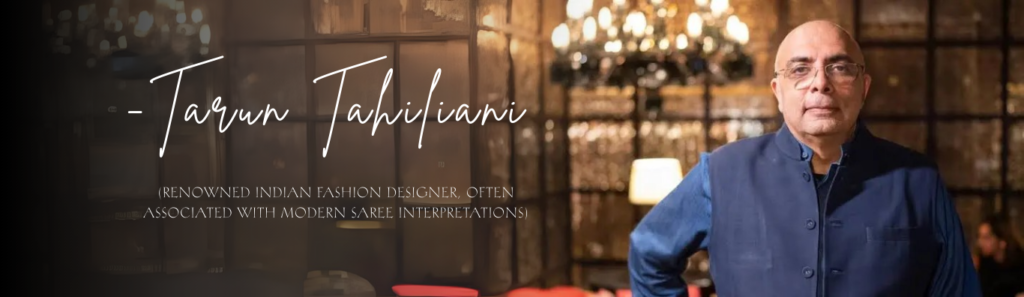
“A saree is not just a garment, it’s a power, an identity, a language, a history, a culture, a tradition, a memory, a story, a poetry, an art, a passion, a journey, a feeling, a moment, a style, a love, a life.”
— Tarun Tahiliani
Collection & Evolution – A Tapestry of Styles
Regional Diversity (Highlight 5-7 key regions):
North India (Uttar Pradesh, Rajasthan): Banarasi (heavy silk, gold/silver brocade for weddings), Bandhani (tie-dye), Leheriya (wave patterns).
West India (Maharashtra, Gujarat): Paithani (peacock motifs, rich borders), Nauvari (9-yard, Maharashtrian drape). Kanjeevaram (Tamil Nadu influence, often worn in Gujarat/Maharashtra).
East India (West Bengal, Odisha): Tant (crisp cotton), Baluchari (mythological scenes), Sambalpuri (Ikat weaves).
South India (Tamil Nadu, Karnataka, Kerala): Kanjeevaram (heavy silk, rich borders), Mysore Silk (Karnataka, lighter silk), Kasavu (Kerala, white/off-white with gold border).
Central India (Madhya Pradesh): Chanderi (light, sheer silk-cotton with zari), Maheshwari (reversible border).
Modern Interpretations & Contemporary Evolution:
Designer Sarees: Influence of designers (Sabyasachi, Manish Malhotra) in popularizing fusion styles, pre-draped sarees, and experimental fabrics.
Fabric Innovations: Beyond silk and cotton to georgette, chiffon, crepe, net, and even denim sarees.
Draping Styles: Modern drapes (mermaid, lehenga-style), pre-stitched sarees for ease.
Blouse Styles: Experimentation with contemporary blouse designs (off-shoulder, full-sleeved, peplum).
Global Appeal: Saree as a global fashion statement, worn by international celebrities.
The Art of Draping (Brief Mention)
- Briefly touch upon how different drapes reflect regional identity and utility (e.g., working drapes vs. festive drapes).
- No need for a detailed “how-to,” but emphasize the versatility.